

From 31 October, parish councils and ward councillors can no longer call planning applications in to committee. In 2026, 10 of 23 cases got there no other way.
Parish councils in South Cambridgeshire lose the power to send planning applications to the district’s Planning Committee on 31 October. Ward councillors lose it too.
The change comes from a new national scheme of delegation, which every council in England must follow from that date. A report to the committee’s meeting on 14 October sets out what it means here.
We went through every application on the committee’s agendas this year to see how much difference it makes. Of the 23 applications heard since January, 10 reached the committee only through a call-in or the number of objections. Both routes are being abolished.
What changes on 31 October
The rules are in the Town and Country Planning (Discharge of Local Planning Authority Functions) (England) Regulations 2026. The report lists the key changes:
- No more call-ins. Individual ward councillors and parish councils can no longer call an application in to the committee.
- No more objection trigger. At present, five or more representations put an application before a delegation panel, which can refer it to committee. That threshold goes.
- Small schemes are always decided by officers. Householder applications, schemes of one to nine homes on sites under half a hectare, minor commercial schemes, discharge of conditions and most prior approvals cannot go to committee at all.
- Bigger schemes need two people to agree. Major housing and commercial schemes, and those affecting heritage, are still presumed to be decided by officers. They go to committee only if a nominated officer and the committee chair both agree they meet strict tests.
The report warns that any committee decision reached through an abolished route after 31 October would be “legally void and highly vulnerable to judicial review”.
How cases got to committee this year
Each officer report states why the application came to committee. We read all 23 from the meetings between January and October.
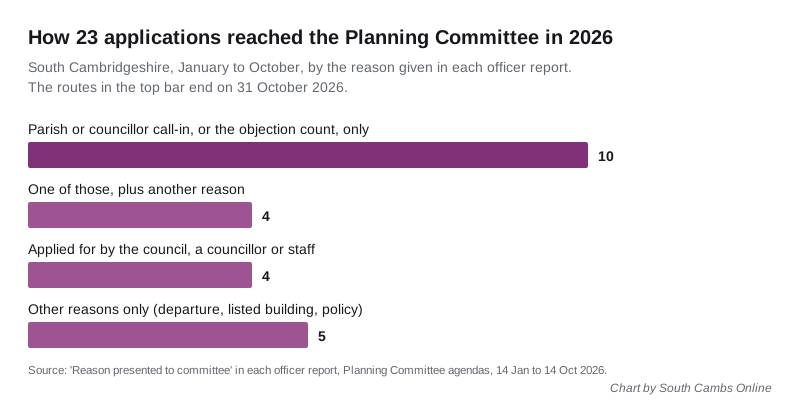
These are the ten that got there only by a call-in or the objection count:
| Meeting | Where | What was proposed | How it got there |
|---|---|---|---|
| January | Woodlands Road, Great Shelford | Replace a house with a self-build home | Objections, parish request |
| February | Thriplow Farm, Thriplow | 26 homes on the grain store site | Objections |
| February | Royston Road, Foxton | Three commercial units and seven homes | Objections |
| February | Station Road, Steeple Morden | Two homes | Parish call-in, objections |
| February | Church Close, Great Wilbraham | Four homes | Parish call-in, objections |
| March | Church Lane, Sawston | One self-build home | Objections |
| August | Low Fen Drove Way, Horningsea | Temporary solar farm and battery storage | Parish call-in, objections |
| August | Hurdleditch Road, Orwell | Up to three homes | Parish call-in, objections |
| September | Rushden Close, Fulbourn | Seven homes and an office | Parish call-in, objections |
| October | St Neots Road, Hardwick | Up to 138 homes | Objections |
Four more listed a call-in or objections alongside another reason. One was the 100 homes off Horseheath Road in Linton, which Linton Parish Council called in. The developer has now appealed against the refusal.
The remaining nine came for reasons the new rules keep or treat differently. Four were applications by the council itself, a councillor or a member of staff. Under the regulations, those “own interest” cases still go to committee.
The last meeting under the old rules
The 14 October meeting is the last before the change. Two applications are on the agenda.
- Up to 138 homes south of St Neots Road, Hardwick. It reached committee because of the number of objections: 23, according to the officer report. Officers recommend refusal. Their reasons include the loss of Grade 2 farmland and inadequate surface water drainage.
- Up to eight self-build homes east of Bells Meadow, Guilden Morden. It reached committee because of public comments, and because it departs from the Local Plan. Officers recommend approval. Guilden Morden Parish Council objects, according to the officer report.
Neither would reach the committee by the same route after 31 October.
Who decides from November
The council plans a new Planning Committee Gateway Meeting from 1 November.
- The nominated officer will be the Director of Planning and Economic Development, who can delegate the role to delivery managers and team leaders.
- The nominated member will be the chair of the Planning Committee, with the vice chair as substitute.
- If the two do not agree, the application stays with officers.
- A record of every case considered for referral, and the reason for the decision, will be reported to the committee once a year and published on the council’s website.
The committee itself does not change size. It has 11 members, under the new cap of 13.
What it means for you
- Your objection still counts. Officers must still weigh every comment made on an application. What ends is the guarantee that enough objections, or a request from your parish council, will bring it before councillors.
- Only two people can now send a scheme to a public debate: the nominated officer and the committee chair. They can do so only if it raises an issue of economic, social or environmental significance to the area, or a significant planning matter.
- Extensions and small housing schemes will be decided by officers, whatever the level of local feeling.
- Parish councils are still consulted. Their views appear in the officer reports, as Guilden Morden’s objection does this month.
The committee meets at 10am on Wednesday 14 October at South Cambridgeshire Hall in Cambourne. The agenda and papers are online. Our planning news page tracks the district’s bigger schemes.
Have your say